Where Did All the Small Cars Go? Canada’s Affordable Commuters Are Disappearing
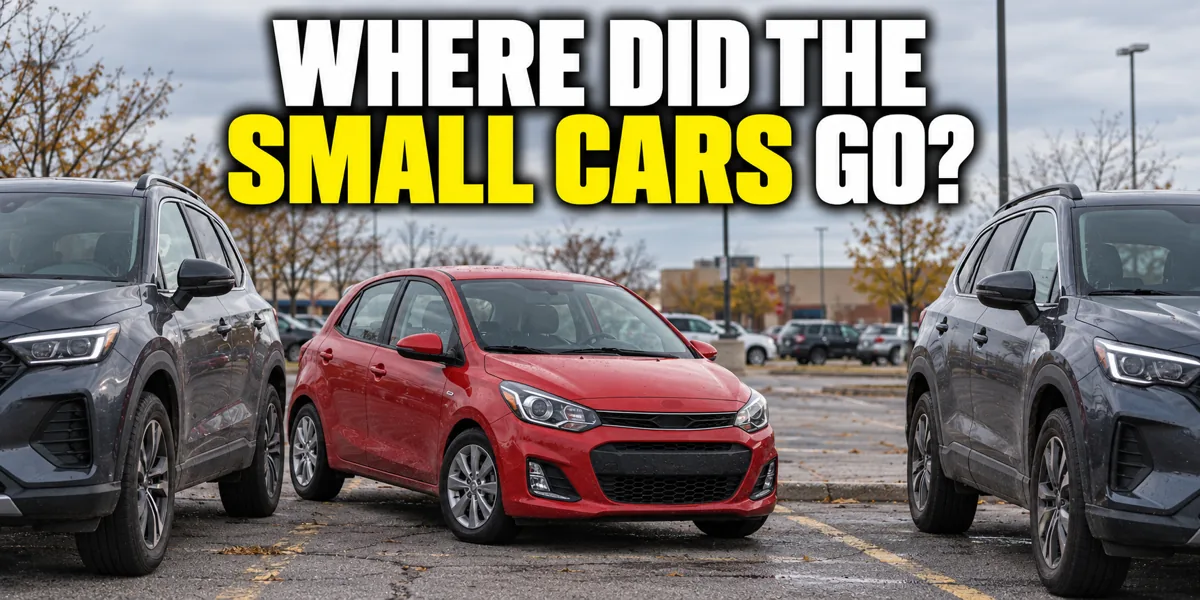
I used to own a Chevrolet Spark. It was my commuter car.
There was nothing fancy about it, and that was the point. It saved gas, fit into almost any parking spot and did the everyday job I bought it to do. I did not need a large SUV to drive to work or pick up a few groceries.
Cars like that once filled Canadian roads. The Toyota Tercel gave way to the Echo and Yaris. We had the Honda Fit, Chevrolet Spark, Nissan Micra, Kia Rio, Hyundai Accent and Mazda2. One by one, they disappeared from new-car showrooms.
Canadians can still buy compact cars such as the Honda Civic, Toyota Corolla and Mazda3. The true entry-level subcompact, the little car that puts low running costs ahead of size and image, has almost vanished.
Why did small cars disappear from Canada?
Canada shares most vehicle planning with the larger United States market. As buyers moved toward crossovers, manufacturers dropped low-margin subcompact cars and used their factories and dealer space for vehicles that earn more. Canadians still need basic commuter cars, but that demand is smaller than the market for crossovers.
| Small car | Current Canadian status | Brand's suggested direction |
|---|---|---|
| Chevrolet Spark | Discontinued | Trax or Trailblazer crossover |
| Mitsubishi Mirage | 2024 was the final model year | RVR crossover |
| Nissan Versa | Discontinued as of 2025 | Sentra car or Kicks crossover |
Canada followed the North American market
Canada has its own driving conditions and buying habits, but manufacturers plan most vehicle lineups for North America. The United States has a much larger market, so its sales trends carry more weight when a company decides what to build here.
Once American buyers moved toward SUVs and crossovers, the business case for a Canada-only small car became hard to defend. A manufacturer still has to certify the vehicle, stock parts, train technicians, advertise it and support it across a large country. Spreading those costs over a modest number of Canadian sales does not look attractive beside a crossover that can sell on both sides of the border.
That also explains why we cannot fill the gap by bringing over every small car sold in Europe or Asia. Transport Canada says vehicles designed for markets outside Canada, the United States and Mexico normally do not meet Canadian requirements and usually cannot be modified to comply. A manufacturer needs to certify and support a vehicle for this market.
Crossovers make more money
A small car needs many of the same costly parts as a larger vehicle. It still needs airbags, cameras, crash engineering, emissions equipment, infotainment and driver-assistance technology. Those costs do not shrink as much as the car does, while the subcompact gives the manufacturer less room for profit.
A manufacturer can use similar mechanical parts in a taller crossover and earn more from the sale. The Canadian Automobile Dealers Association's 2025 industry study says manufacturers have phased out lower-cost, lower-margin cars while replacing many of them with SUVs and crossovers.
Look at what the brands themselves suggest. Chevrolet directs former Spark shoppers toward the Trax and Trailblazer. Nissan points Versa shoppers to the Sentra and Kicks. Mitsubishi presents the RVR as the next step after the Mirage. All three brands now steer entry-level buyers toward larger models.
Buyers moved toward SUVs, then the choice moved with them
Canadian buyers helped create this change. Many wanted all-wheel drive, easier entry, more cargo room and a higher seating position. Small crossovers offered those features without feeling as large as a three-row SUV.
The sales numbers show how far the market has moved. Statistics Canada reported that vehicles in its broad truck category, which includes SUVs, minivans, pickups and vans, made up 88 per cent of new-vehicle sales in 2025. Passenger-car sales fell from 496,851 in 2019 to 234,278 in 2025, a drop of 52.8 per cent.
Those numbers do not prove that 88 per cent of Canadians wanted a large truck. A small crossover counts in the same broad category. They do show that the traditional car has lost most of the showroom.
Supply also affects demand. When a dealer no longer has a Fit, Spark or Micra to offer, a buyer cannot choose one. The buyer picks from the vehicles on the lot, and that sale becomes more evidence that Canadians prefer crossovers. The cycle keeps feeding itself.
Small cars became harder to justify
Drivers used to accept a basic interior, a small engine and a manual transmission because the whole package made sense. As safety and technology requirements grew, the smallest cars gained equipment and cost. They no longer stood far enough apart from a roomier compact car or small crossover.
That created a tough conversation in the showroom. When the next model offers more room and capability, many buyers move up. The small car then sells in lower numbers, which makes it even harder for the manufacturer to justify another generation.
The end of the segment came quickly. Chevrolet now lists the Spark as discontinued. Mitsubishi says the 2024 model year was the last for the Mirage. Nissan says the Versa was discontinued as of 2025. These were among the final new subcompact cars available in Canada.
Demand still exists
Students, retirees, commuters, delivery drivers and two-car households can all make good use of a small, efficient vehicle. City drivers still value a car that can slip into a tight parking space. My Spark handled the commuter job without asking me to haul around space I did not need.
Mitsubishi says it sold more than 27,000 Mirages in Canada over the model's life. The company sold 1,776 in 2025 as the car reached the end of its run. That is a real customer base, but it remains small beside a national new-vehicle market of almost two million units.
Automakers can sell small cars. They believe they can earn more by using their factories, marketing budgets and dealer space for crossovers.
Canadian drivers now feel the loss most at the entry level. The simple new commuter has disappeared, so buyers look at a larger new vehicle or compete for a limited supply of used Fits, Sparks, Micras, Yaris models and Mazda2s.
Winter did not kill the small car
Canada had small cars through decades of snow and cold. A front-wheel-drive hatchback with proper winter tires can handle an ordinary winter commute. Ground clearance matters on an unplowed rural road, but most commuters do not need SUV clearance every morning.
Winter helped crossovers sell because all-wheel drive and extra height feel reassuring. It does not explain why the small-car market collapsed across North America. Product planning, profit margins and the shift in showroom choice explain much more.
The Spark also showed how efficient a simple gas car could be. Natural Resources Canada rated the 2022 automatic Spark at 7.0 L/100 km combined. That kind of fuel use still makes sense for a daily commute.
Could small cars return?
They could, but the old formula may not come back soon.
A manufacturer would need enough buyers, a business case that works and a model that meets Canadian rules. Higher fuel costs could renew interest. A company could also bring a small hybrid or electric car to market, although battery cost makes a basic entry-level model difficult.
Canada could see more choices if manufacturers certify small global models for North America. Until that happens, compact sedans and small crossovers will carry most of the entry-level market.
The used market remains the practical place to look for the kind of car we once bought new. A used small car can still make a great commuter, but age matters. Check for rust, collision history, recalls, maintenance records and the condition of the winter tires. Neglect can turn a simple commuter into a repair project.
FAQ
Why did automakers stop selling small cars in Canada?
Small cars sold in lower volumes and produced less profit than crossovers. Canada also shares most vehicle planning with the larger United States market, where buyers moved strongly toward SUVs and trucks.
Can you still buy a new subcompact car in Canada?
True entry-level subcompact cars have almost disappeared. The Chevrolet Spark and Mitsubishi Mirage have ended production, and Nissan says the Versa was discontinued as of 2025. Compact cars such as the Civic, Corolla and Mazda3 remain available.
Do Canadians still want small cars?
Yes, especially commuters and urban drivers. The demand exists, but automakers can earn more from larger crossovers and have directed most entry-level buyers toward them.
Are small cars bad in Canadian winters?
No. Proper winter tires matter more than body style for many ordinary commutes. A small front-wheel-drive car can work well in winter, though drivers on deep, unplowed roads may need more ground clearance.
Can I import a small car from Europe or Asia?
Canada's general federal age exemption is 15 years, not 10. Officials calculate age from the month and year of manufacture. A younger vehicle built for a market outside Canada, the United States or Mexico normally cannot be imported permanently unless another exception applies. A vehicle that reaches 15 years must still meet border entry and provincial registration requirements.
The simple car filled a real need
My Chevrolet Spark was not luxurious or exciting. It represented something useful: a car could be enough without trying to be everything.
Small cars disappeared because North American buyers moved toward crossovers and automakers followed the more profitable sale. Canadians still need simple transportation, but new-car lineups now offer far fewer ways to buy it.
If you want help finding a commuter that fits your daily drive, tell me how you will use it. I will help you compare the practical choices that are still available.
Sources: Statistics Canada, Springing into a New Motor Vehicle; Canadian Automobile Dealers Association, The Road Ahead, June 2025; Transport Canada guidance for importing vehicles from countries other than the United States and Mexico; Canada Border Services Agency Memorandum D19-12-1; Chevrolet Canada discontinued vehicles; Nissan Canada discontinued Versa; Mitsubishi Motors Canada Mirage history and 2025 sales results; and Natural Resources Canada 2022 Fuel Consumption Guide. Thumbnail: Cars with Ryan.